UGC Strategy19 min read
UGC Usage Rights: Contract Clauses, Terms and Expiry Dates
What UGC usage rights cover, how long to buy them, clauses to copy into the contract, and what to do when they expire, plus Spark Ads, music and AI.
Short answer:
- UGC usage rights are the license a creator gives you to use a video they made: where it can run, for how long, in which countries, and whether you can edit it or put ad money behind it. Paying for the video doesn't make it yours. In the US, copyright starts with the creator unless a signed contract says otherwise.
- Buy organic and paid use separately, give every right an end date, and agree the renewal price before filming. Whitelisting, exclusivity, raw files, music and any AI or likeness use are separate lines too.
- A TikTok Spark Ads code or a Meta partnership ad permission lets you boost a post. It doesn't replace the usage rights in your contract.
- When paid rights expire, the ads have to stop. Log every end date and set a reminder two weeks before it.
Most usage rights problems show up months after the shoot. A video wins, it runs for a year, and then someone notices the contract said six months, or said nothing at all. The guides that rank for this topic explain organic versus paid and roughly what each costs. This one adds what they skip: a rights matrix to check every deal against, clause wording you can paste into a contract, what to do on the day rights expire, and where Spark Ads codes, music, AI likeness clauses and AI avatars fit. It's written from the brand side with US law as the reference. It's general information, not legal advice, so have a lawyer read anything you sign for real money.
What UGC usage rights are, and who owns the video
When a creator films a video, they own the copyright. US law says copyright "vests initially in the author or authors of the work" (17 U.S.C. § 201), and paying for the video doesn't change that on its own. What you buy is a license: permission to use the video in specific ways, for a specific time. Usage rights are the terms of that license.
There are two ways to own the video outright instead. The first is an assignment, where the creator transfers the copyright to you. An exclusive license counts as a transfer too (17 U.S.C. § 101), and a transfer "is not valid unless an instrument of conveyance, or a note or memorandum of the transfer, is in writing and signed by the owner of the rights conveyed" (17 U.S.C. § 204). The second is a work made for hire. For a freelancer, that only covers certain kinds of commissioned work, including "a part of a motion picture or other audiovisual work," and only when both sides sign a written agreement that expressly calls it a work made for hire. The Copyright Office's Circular 30 is blunt: "If a work fails to satisfy any of these requirements, it is not a work made for hire."
Most UGC deals need neither. A non-exclusive license for the channels and the period you'll actually use costs far less than a buyout, and it's what creators expect. Whatever you choose, write it down. A DM that says "sure, use it" is hard to rely on when nobody remembers whether it meant ads.
The UGC usage rights matrix
This is the table to check every creator deal against. Each row is a separate right with its own term, and each one belongs in the contract as its own line.
| Right | What it lets you do | Typical term | What to write in the contract |
|---|---|---|---|
| Organic social | Post the video on your own brand accounts, no ad spend | Often included in the base fee | The accounts and platforms, and whether posts stay up after the term |
| Owned channels | Use it on your website, product pages, email or app | Set one per channel | Each channel by name; anything not named isn't covered |
| Paid ads from your account | Run it as an ad under your brand name | 3 to 6 months by default, 12 for proven winners | Platforms, countries, start date, end date, renewal price |
| Whitelisting, Spark Ads, partnership ads | Run ads from the creator's own handle | Its own period, on the code and in the contract | Platforms, period, who generates the code, the fee |
| Edits | Cut, crop, caption, translate, combine with other footage | Same as the license it belongs to | What you may change, and what you may not (the meaning of what they say) |
| Raw files | Get the unedited takes and B-roll to make new versions | Same as the paid license | That raw files are delivered and new edits fall under the same rights |
| Exclusivity | Keep the creator from promoting named competitors | Short and narrow | Named competitors or a narrow category, the months, a separate fee |
| Perpetual or buyout | Use it with no end date, or own it | No end date; the most expensive option | "Perpetual" in so many words, or a signed assignment |
| Likeness, voice and AI | Use their face or voice beyond this video, train models, make AI variants | Only with separate, specific consent | A clear ban, or a separate signed consent that lists each use |
| Music | Keep a song in the paid ad | Only as licensed by the music owner | Who supplies audio; default to no music in delivered files |
The default terms come from Make Influence, which recommends "three to six months with a pre-agreed renewal option" for most ecommerce brands and twelve months only once an asset has proven itself (Make Influence), and from JoinBrands, whose list of common windows is "30, 90 or 180 days, 12 months or perpetual" (JoinBrands). Organic use being part of the base fee is what inBeat reports (inBeat). None of this is a legal standard. It's what most creators will recognize when you send the offer.
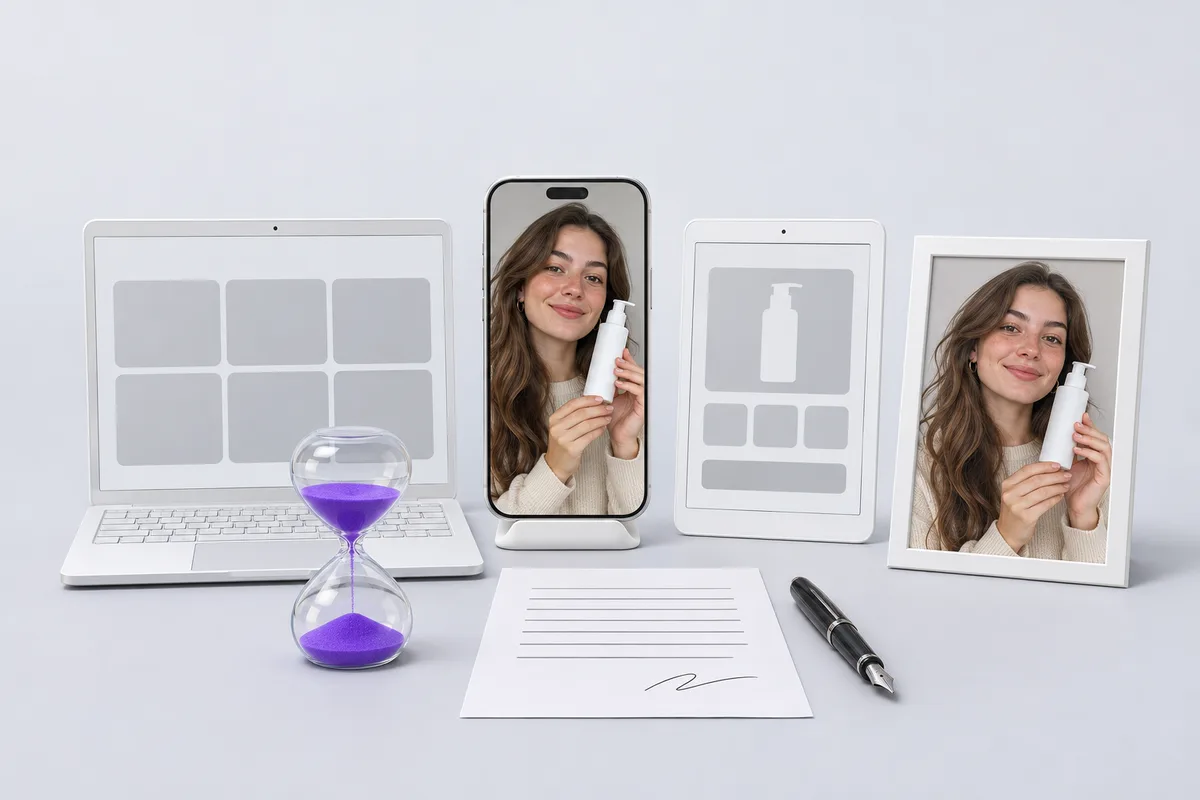
One video, many places it could run. Each channel and each time window is a separate right. Illustration generated with AI.
Organic vs paid usage rights
Organic use means the video sits on accounts you control and nobody pays to show it. Paid use means you put money behind it, so it reaches people who never followed you, often for months. Creators price the two differently because a winning ad gets far more views than a repost, and it ties their face to your brand for the whole run.
The safe reading of any contract is simple: if it doesn't mention paid ads, assume you can't run paid ads. Boosting an organic post counts. So does dropping the video into an ad set as one of five creatives. Our UGC rates guide lists the usual add-on percentages for paid windows, perpetual rights and whitelisting, so they aren't repeated here. In short, paid use is priced on top of the base fee, and the longer and wider the license, the more it adds.
How long should UGC usage rights last?
Match the term to what you'll actually do with the video. For a new creative you're testing, Make Influence's default of three to six months with a renewal option is long enough to test and scale, and short enough that you're not paying for months you won't use. Twelve months makes sense for a video that has already proven itself. Perpetual rights rarely make sense for paid social, because most ads wear out long before the license would.
Say when the clock starts. "Six months" can mean from signing, from delivery or from the first ad, and the gap can be weeks. Make Influence prefers the delivery date because it's "cleaner and easier to track." Whatever you pick, put a calendar date in the contract, not just a length.
Agree the renewal price now. Extending later is usually possible, but by then the video is a proven winner and the creator knows it. A line like "renewable for a further 6 months at [price], by written notice before the end date" settles it in advance. A contract reviewer who posted in r/UGCcreators warns creators that "if the contract doesn't name a window, that is not an accident." Brands should read that as a warning too. A missing end date doesn't settle anything. It just moves the argument to the worst possible moment, when the ad is working.
Copy-paste usage rights clauses
Here is clause wording to adapt. It's written as a usage schedule you attach to the creator agreement, and it lines up with the usage section of our UGC brief template, so the brief and the contract say the same thing. Replace everything in brackets, delete what you aren't buying, and have a lawyer check it against your local law before you rely on it.
USAGE RIGHTS SCHEDULE

1. Grant. Creator grants Brand a non-exclusive license to use
   the videos listed in Annex A ("Content") as set out below.
   Creator keeps the copyright.

2. Channels. Organic: Brand's own accounts on [Instagram,
   TikTok, Facebook, YouTube]. Owned: [website, product pages,
   email]. Paid: ads on [Meta, TikTok] only. Any channel not
   listed here is not included.

3. Term and territory. Organic and owned use: [12 months /
   no end date]. Paid use: [6] months from [date of delivery],
   ending on [calendar date]. Territory: [United States].

4. Edits. Brand may cut, crop, caption, translate, add graphics
   and combine the Content with other footage, but will not
   change the meaning of what Creator says.

5. Raw files. Creator delivers all usable takes and B-roll.
   New edits made from raw files are covered by this license
   and end when it ends.

6. Creator-account ads. Creator will provide a TikTok Spark Ads
   code and/or Meta partnership ad permission for [period].
   These permissions do not extend the term in clause 3.

7. Exclusivity. For [60] days from delivery, Creator will not
   publish paid content for [named competitors]. Fee: [amount].

8. Renewal. Brand may extend paid use by [6] months for
   [amount], by written notice before the end date.

9. End of term. When paid use ends, Brand will stop the Content
   in all ads, including copies in other campaigns, within [5]
   business days. Organic posts published during the term
   [may / may not] stay up.

10. Likeness and AI. Brand will not use Creator's name, face or
    voice outside the Content, use the Content to train AI
    models, or create synthetic or AI-altered versions of
    Creator, without Creator's separate written consent.

11. Music. Content is delivered without music. Brand is
    responsible for licensing any music it adds.

12. Fees. Base fee [amount] + paid usage [amount] + extras
    [amount] = [total], payable [terms].
Three clauses do most of the work. Clause 2's last sentence closes the "we assumed email was included" gap. Clause 6 stops a long Spark Ads code from quietly stretching a short license. And clause 9 is the one most templates leave out: it says what "stop" means and how fast, which is exactly what both sides argue about later.
For the creator's side of the same contract, this video from a creator lawyer walks through the terms she checks first, with usage rights and ownership near the top:
Spark Ads codes and partnership ads are not usage rights
Running ads from the creator's account is a different permission from the license to use the video. On TikTok, the creator generates a Spark Ads code for a post, and TikTok lets you "customize the duration of your authorization code to meet campaign needs and minimize costs" (TikTok, About Spark Ads). On Meta, partnership ad permissions work differently: access lasts until the creator revokes it (Meta, partnership ad permissions).
Both are switches inside the ad platforms. They decide whether you can boost a specific post. They don't record what you paid, which countries you may target, whether you can download the file and cut new versions, or what happens when the deal ends. That's the contract's job. If the code says 60 days and the contract says six months, the two will disagree on day 61, so make them match. And since a Meta permission can stay on long after the deal is over, the contract needs its own end date even when the platform doesn't set one. Our TikTok Spark Ads guide covers how the codes and permissions work step by step.
What happens when UGC usage rights expire
When the paid term ends, the ads stop. JoinBrands puts it plainly: "Stop running the content as ads and remove it from paid placements" (JoinBrands). Organic posts are a separate question, and the contract should answer it, which is what clause 9 above is for.
In practice, expired videos keep running because nobody owns the date. Make Influence calls "expired creatives left running in an ad account" a "common and entirely avoidable problem," and suggests a calendar reminder two weeks before the end (Make Influence). A reminder only works if someone can act on it, so keep one rights log for every creator video: the file name, the creator, the rights you bought, the start and end dates, the renewal price, and the ad IDs where the video runs. A shared spreadsheet is enough.
Put the end date where the media buyer sees it. Naming the ad maya_hookA_paid-until-2027-05-31 means anyone scrolling Ads Manager knows when it has to stop. When the date comes, search the whole account for the file, not just the original campaign. Winning videos get duplicated into new ad sets, new campaigns and other markets, and every copy has to stop.
If the video is still winning, renew before the date, not after. JoinBrands notes that extending is "usually far cheaper than finding a new winner." Running past the end date means using someone's copyrighted work without a license. Under US law, statutory damages run from $750 to $30,000 per work, and up to $150,000 when the infringement is willful (17 U.S.C. § 504), although they're only available for works registered in time (17 U.S.C. § 412). Even without a lawsuit, you lose the creator, and creators talk to each other.
Likeness, voice and AI: the clause to read twice
Copyright covers the video. The creator's face, name and voice fall under a different set of laws, the right of publicity, and those vary by state. California's is a common reference: anyone who "knowingly uses another's name, voice, signature, photograph, or likeness" for advertising "without that person's prior consent" is liable for damages, with a minimum of $750 (Cal. Civ. Code § 3344). A usage license for one video is consent to that video. Don't treat it as consent to put the creator's face in a new ad, clone their voice or generate an AI version of them.
New York goes further for AI. Under its digital replica law, a contract clause that allows a digital replica of a person's voice or likeness "in place of work the individual would otherwise have performed in person" is void if it lacks "a reasonably specific description of the intended use" and the person wasn't represented by a lawyer or a union in that deal (N.Y. Gen. Oblig. Law § 5-302). Most UGC creators negotiate alone, so a vague "Brand may use the Content with any technology now known or later developed" is the kind of clause that may not hold up.
Creators are watching for these clauses. The same contract reviewer in r/UGCcreators lists them as a new one to look out for:
“newer one to watch: clauses letting them train ai on your content or make a "digital replica" of your voice/face. there's no settled price for this and the downside is open ended.”
A post on r/UGCcreators
The poster's advice to creators is to strike the clause or price it as a full buyout. For a brand, the cleaner path is clause 10 above: no AI or likeness use beyond the delivered video unless you both sign a separate consent that says what you'll make, where it runs and for how long. If you want AI variants of a real creator, make that its own deal with its own fee.
Music inside UGC videos
Music is a rights problem the creator usually can't solve for you. A song carries two copyrights, the composition and the recording. The Copyright Office puts it this way: "Sound recordings and musical compositions are considered two separate works for copyright purposes" (Circular 56A). A creator who adds a trending track to their video hasn't licensed either one for your ads.
TikTok's rule for brands is direct: "Businesses cannot use the general music library for commercial usage." It points them to the Commercial Music Library instead, for organic posts, video ads and branded content (TikTok, About the Commercial Music Library). That library is built for content on TikTok, so don't assume the same track is cleared when the video runs on Meta or YouTube; check its terms first. The simplest fix sits in the brief: ask for files with no music and add licensed audio yourself.
Usage rights when the creator is an AI avatar
With an AI UGC tool there's no creator to license from, so there's no creator usage fee, no paid window to track and nothing that expires after six months. What you have instead is the tool's terms. Read them before you run ads: who may use the output commercially, what the avatars may be used for, and who answers for what the ad says.
For our own tool (UGC Builder is our product), the FAQ in the docs answers the commercial question with "Yes, you have full commercial rights to all content generated through UGC Builder," and the terms of service say ugcbuilder "is not responsible for user-generated content or how it is used." So the claims in the ad, the product you show and any music you add are still your responsibility. Plans start at $9 a month for 100 credits, and a 5-second video uses 20 credits.
Two things work differently from human UGC. The first is ownership. The US Copyright Office concluded in January 2025 that AI outputs "can be protected by copyright only where a human author has determined sufficient expressive elements," and that this doesn't include "the mere provision of prompts" (U.S. Copyright Office). Your script and the way you edit and arrange the clips can be protected, but a generated clip on its own may not be, which makes a competitor's copy harder to stop. The second is disclosure. An avatar isn't a customer, so it shouldn't talk like one, and Meta and TikTok have their own labels for AI-generated ads. Our AI ad disclosure guide covers those rules, and our AI UGC vs real UGC comparison covers where each one works better.
FAQ
Who owns UGC content, the brand or the creator?
The creator, unless a signed contract transfers it. In the US, copyright starts with the person who made the work, and a transfer has to be in writing and signed. Most brands buy a license instead: the right to use the video in set ways for a set time.
What's the difference between organic and paid usage rights?
Organic rights let you post the video on your own accounts and site without ad spend. Paid rights let you put money behind it as an ad. They're priced and written separately, and if the contract doesn't mention paid ads, assume you don't have them.
How long should UGC usage rights last?
For paid ads, three to six months with a renewal price agreed up front is a common default, and twelve months for a video that has already proven itself. Write a start date and an end date into the contract, not just a length.
What are perpetual usage rights?
A license with no end date. It's the most expensive option and rarely worth it for paid social, because most ads wear out long before the license would. It also isn't the same as owning the copyright unless the contract assigns it in writing.
Is whitelisting the same as usage rights?
No. Whitelisting, Spark Ads and partnership ads let you run ads from the creator's account. Usage rights are the license that says where, for how long and on what terms you can use the video. You need both, and their dates should match.
- UGC
- UGC Creators
- Video Ads
- TikTok Ads
- Meta Ads